Written By: Undefeated Healthcare Editorial Team
Reviewed By: Chase Butala MS LPC, LCPC
You ever open up to someone, say something real, maybe even brave… and then 30 minutes later you feel like you need to delete yourself from existence, move to a new city, and pretend that conversation never happened?
Yeah. That crash after vulnerability has a name: vulnerability hangover .

And if you’re dating in your 20s, 30s, or 40s while trying to actually build something real, this is probably quietly sabotaging more of your relationships than you realize.
Not because you’re “too sensitive.” Because your nervous system is doing exactly what it was designed to do.
The problem is, it’s doing it a little too aggressively.
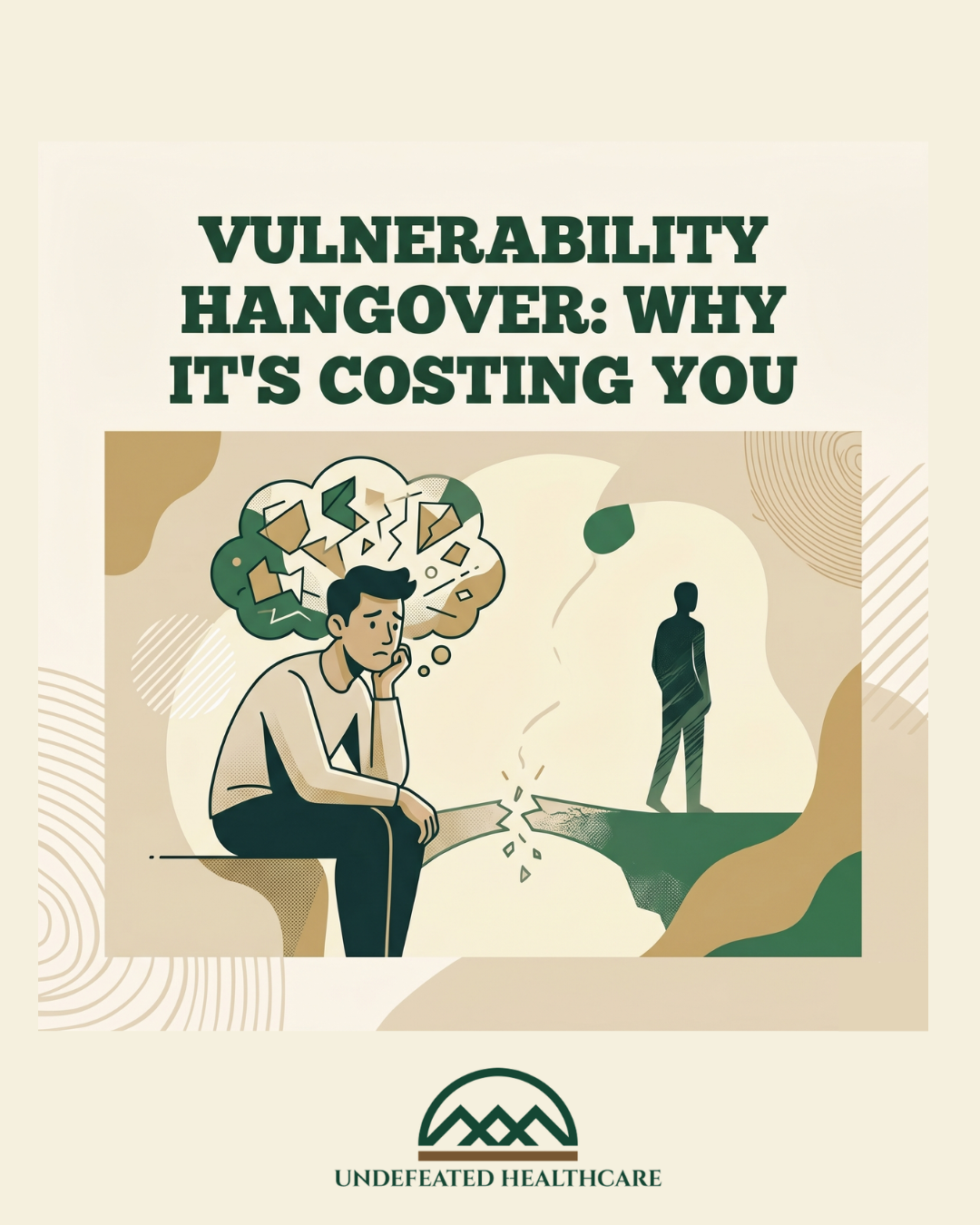
A vulnerability hangover is the emotional “crash” that happens after you share something personal, honest, or emotionally exposed.
Overthinking everything you said
Feeling embarrassed or “too much”
Wanting to retract or minimize what you shared
Suddenly seeing the other person as judgmental or unsafe
Pulling away emotionally or going cold
Think of it like emotional jet lag. You showed up fully human for a moment… and your brain immediately tries to “correct the risk.”
Your brain does not care about your dating life.
It cares about survival, belonging, and rejection risk .
So when you share something real like:
“I actually get anxious when I really like someone”
“My last relationship really hurt me”
“I want something serious, not casual”
Your nervous system sometimes interprets that as:
“We might get rejected. We might lose belonging. Sound the alarm.”
So after the moment of courage comes the backlash: the hangover.
Research on social evaluation and rejection sensitivity shows that humans process perceived rejection similarly to physical pain.
A 2021 study published in Social Cognitive and Affective Neuroscience found that social rejection activates similar neural pathways as physical pain responses, especially in individuals with higher sensitivity to interpersonal evaluation.
The American Psychological Association (APA, 2023) has also highlighted that stress related to social evaluation and relationship uncertainty is a major contributor to anxiety symptoms in adults, particularly in dating contexts.
Continue reading the full field note
Social anxiety affects roughly 7% of U.S. adults annually (NIMH, 2023)
Relationship stress is one of the top reported sources of chronic stress in adults (APA Stress in America Report, 2023)
So no, you’re not “dramatic.” You’re human in a high-stakes emotional environment.
Marcus goes on a great date in Frederick, Maryland. He opens up about wanting something serious. The date responds positively.
“She probably thinks I’m needy”
He starts emotionally detaching before she even replies
Jasmine shares past relationship trauma with someone she likes in Morgantown, WV.
Starts critiquing him unfairly
Feels irritated instead of connected
Not because anything changed.
Because vulnerability triggered internal threat response.
Vulnerability hangover shows up at:
Work (speaking up in meetings, then second-guessing yourself)
Family (sharing feelings, then regretting it)
Relationships (intimacy followed by withdrawal)
Left unchecked, it creates a pattern:
closeness → exposure → anxiety → withdrawal → disconnection
And that pattern will absolutely wreck dating outcomes.
Men : often feel it as shutdown, emotional suppression, or “I shouldn’t have said that”
Women : often feel it as rumination, self-criticism, or emotional overwhelm
All genders : increased avoidance of future vulnerability
In relationships, this creates confusion:
One person thinks things are deepening
The other is already emotionally retreating
That mismatch is where ghosting, mixed signals, and “what happened?” breakups are born.
If you cannot tolerate the emotional aftershock of honesty, you will keep choosing relationships that require less honesty.
safer but shallower connections
attraction without stability
chemistry without security
And eventually frustration that “nobody is emotionally available”
The pattern isn’t just them.
It’s the nervous system rebound after you do open up.
As comedian Chris Rock once joked about relationships:
“You ever notice that married people always say ‘communication is key’? Yeah… and also silence is survival.”
Funny because it’s true. People avoid honesty because they don’t trust what comes after it.
Dr. Brené Brown, researcher on vulnerability and shame, writes:
“Vulnerability is the birthplace of love, belonging, joy, courage, empathy, and creativity.”
But here’s what people miss: Vulnerability also feels like danger before it feels like connection .
That “hangover” is the nervous system lagging behind emotional courage.
At Undefeated Healthcare, we don’t treat vulnerability hangover as weakness.
We treat it as untrained capacity for emotional intensity .
Because here’s the shift:
Old mindset: “I shouldn’t have said that”
Undefeated mindset: “My system is learning how to stay present after honesty”
That is strength training for relationships.
The 90-Second No-Revision Rule (based on emotion regulation research by Dr. Jill Bolte Taylor, 2020+)
After you share something vulnerable:
Do not analyze it for 90 seconds
Do not “fix” your tone or meaning
Name 3 physical sensations in your body
Let the wave peak and fall without action
Why it works: Emotional arousal naturally peaks and begins to drop within ~90 seconds if you don’t feed it with rumination.
Weekly “Controlled Vulnerability Exposure” Practice
Share one honest thought with a trusted person
Do not retract it afterward
What did I predict would happen?
Did I survive emotional exposure?
This is exposure therapy principles used in CBT and anxiety treatment models.
You are training your brain:
honesty does not equal danger
Why does emotional closeness trigger a threat response in you even when you want intimacy?
What early relational learning taught you that vulnerability must be followed by regret or withdrawal?
How much of your current dating pattern is driven by nervous system reactivity instead of conscious choice?
If you keep cycling vulnerability → regret → withdrawal:
You will repeatedly confuse emotionally available partners
You will self-sabotage early connection
You may end up spending years in “almost relationships”
Financially, this adds up too:
therapy avoidance until crisis point
lost time in incompatible relationships
increased stress-related healthcare use (APA links chronic relational stress with increased healthcare utilization, 2023)
And yes, this is exactly the kind of pattern that makes people say:
“Dating is just not worth it anymore”
It’s unprocessed vulnerability response loops.
Therapy is not about “talking it out.”
It’s about rewiring the sequence:
trigger → interpretation → nervous system response → behavior
At Undefeated Healthcare, clinicians often use:
CBT (Cognitive Behavioral Therapy) : to restructure post-vulnerability thought spirals
Emotionally Focused Therapy (EFT) : to build secure attachment responses in relationships
Somatic therapies : to help the body stop treating emotional exposure as physical threat
Individual therapy helps you regulate internal response.
Couples therapy helps repair the “withdraw after intimacy” cycle in real time.
Group therapy normalizes vulnerability without collapse.
Anxiety & Depression Association of America (ADAA) – https://adaa.org
National Institute of Mental Health (NIMH) – https://nimh.nih.gov
Psychology Today therapist directory – https://psychologytoday.com
SMART Recovery (for emotional regulation skills training groups) – https://smartrecovery.org
NAMI support groups – https://nami.org
emotional regulation in dating anxiety
attachment style vulnerability fear after intimacy
how to stop overthinking after opening up
No. It’s a nervous system response pattern. It can overlap with anxiety or attachment insecurity, but it is not a diagnosis.
Your brain is predicting rejection risk after exposure. That creates shame and overthinking.
Minutes to days depending on stress levels, attachment patterns, and rumination habits.
Yes. Especially approaches that combine cognitive, emotional, and somatic regulation strategies.
If honesty feels like something you regret, the issue is not honesty.
It’s what your nervous system believes will happen after honesty.
And if you’re dating, building relationships, or trying to stop repeating the same emotional cycle, this is exactly the kind of work that changes everything downstream.
We currently have immediate availability , including evenings and weekend appointments . We accept all major insurance plans:
Blue Cross Blue Shield, Aetna, Cigna, UnitedHealthcare, Tricare
The cost of staying stuck in this cycle is usually far higher than your copay.
📞 Phone: 304-270-8179 📧 Email: admin@undefeatedhealthcare.com 🌐 Website: www.undefeatedhealthcare.com
Explore more of our blogs and follow our social media for more evidence-based relational and mental health insights.
Insight matters, but change needs a plan.
This article is educational and doesn’t replace evaluation, diagnosis, or care from a qualified professional.