Written By: Undefeated Healthcare Editorial Team
Reviewed By: Chase Butala MS LPC, LCPC
There’s always that one person.
Different job. Different relationship. Different setting.

You feel fine… until they speak , they text , or they walk into the room .
And suddenly your nervous system acts like it’s in a bar fight it didn’t agree to.
Here’s the uncomfortable truth most people in their 20s don’t get told:
You are not reacting to people.
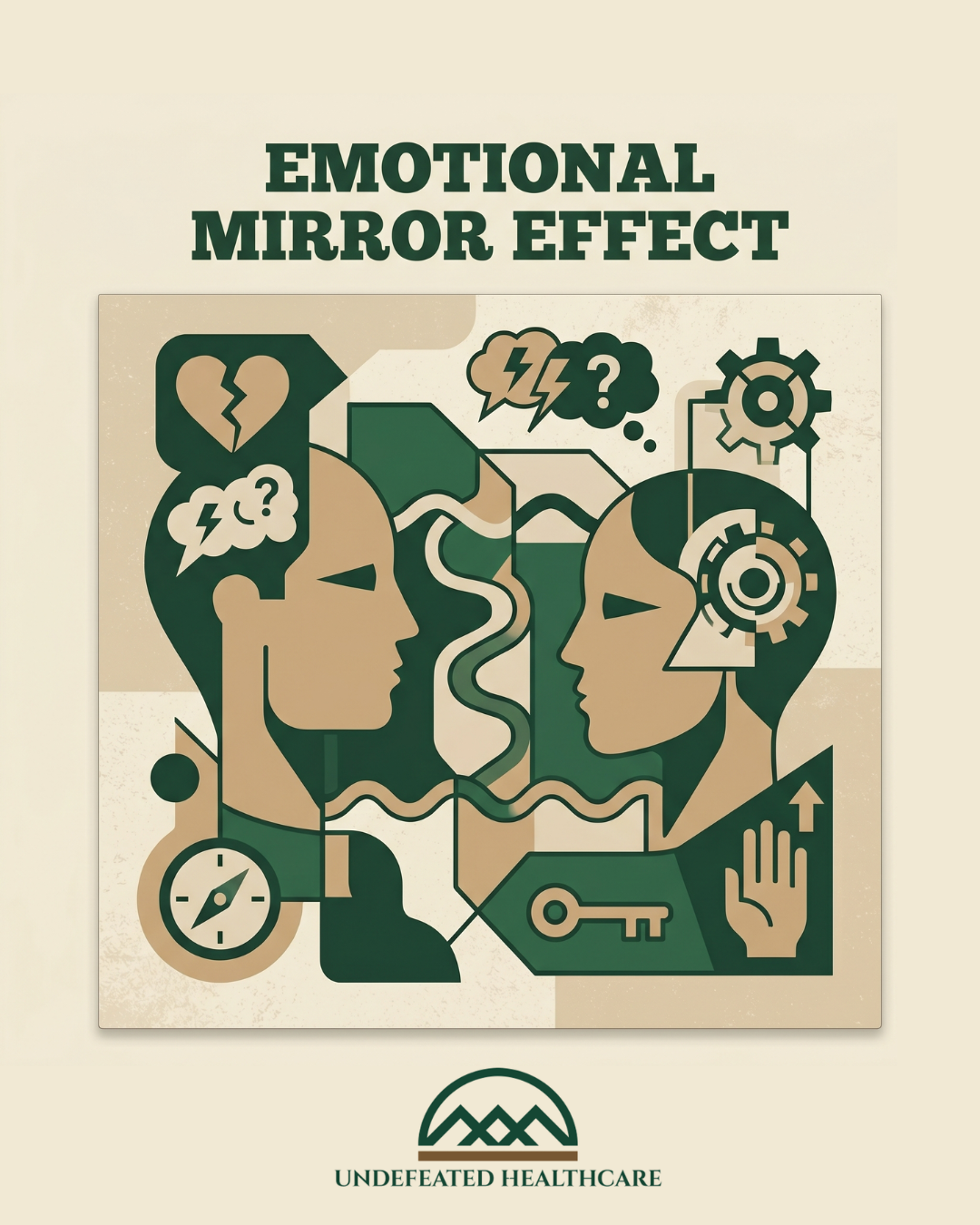
You are reacting to emotional mirrors .
And your nervous system is very selective about which mirrors it hates.
Let’s define it plainly.
An emotional mirror is when another person reflects back something inside you that you haven’t fully processed yet, fear, rejection, shame, control issues, abandonment sensitivity.
“This reminds me of something painful”
“This person is the problem.”
The villain is the automatic emotional interpretation system your brain built to protect you.
It’s fast. It’s loud. It’s outdated.
And it doesn’t ask permission.
Why do you feel instantly disrespected by certain people even before they fully act?
Why do small comments feel like personal attacks?
Why does calm feedback sometimes feel like rejection?
What would it mean if the trigger is yours , not theirs?
If those questions feel uncomfortable, good.
That discomfort is data.
Jordan, 26, sees “k” as a reply.
Instant thought: They don’t respect me.
Reality: coworker is just busy.
Continue reading the full field note
Result: Jordan shuts down communication for days, relationship weakens.
Tasha, 29, hears her partner sigh.
Instant thought: They’re annoyed with me.
Reality: they’re tired from work.
Result: emotional argument about “tone,” not truth.
Emotional reactivity is strongly linked to emotional regulation systems in the brain, particularly the amygdala and prefrontal cortex interaction.
A foundational study by Gross (1998) in Review of General Psychology found that emotional regulation strategies like reappraisal significantly reduce physiological stress responses and impulsive reactions.
How you interpret something determines how your body reacts to it.
The CDC reports that about 1 in 5 U.S. adults experience mental illness each year , many involving emotional regulation challenges.
Emotional dysregulation is highly comorbid with anxiety, depression, PTSD, and relationship instability.
Research consistently shows that individuals with high emotional reactivity are more likely to experience interpersonal conflict and occupational stress.
In clinical practice across Maryland and West Virginia outpatient settings, this pattern shows up constantly in:
Young adult identity transitions
This is not rare. It is just untrained.
Men are often conditioned to convert emotional discomfort into anger, withdrawal, or control behaviors.
Women are often conditioned to convert emotional discomfort into over-explaining, anxiety loops, or relational monitoring.
People in their 20s and 30s often experience the strongest version of this due to identity formation and unstable attachment patterns.
Here’s where most people get stuck:
They think the goal is to “stop being triggered.”
To stop letting triggers make decisions for you.
This is not emotional suppression.
This is emotional leadership.
Avoiding this work because it feels uncomfortable is not strength.
The undefeated mindset is simple:
You don’t eliminate emotional reactions. You train them.
As comedian Kevin Hart once joked:
“I’m not arguing, I’m just explaining why I’m right.”
That’s basically 70% of emotional dysregulation in relationships.
Breathe slowly for 90 seconds
Notice body sensations without reacting
Label the feeling: “I feel threatened / rejected / dismissed”
Why this works: Neuroscience shows emotional surges often peak and begin to decline within ~90 seconds if not fueled by rumination.
Your job is not to fix it.
Your job is to not escalate it .
What story did I immediately create?
What evidence supports or contradicts that story?
What else could this mean?
This builds cognitive flexibility, a core target in Cognitive Behavioral Therapy (CBT).
Why do you keep repeating the same emotional reaction patterns across different people?
What are you protecting yourself from by assuming negative intent quickly?
What would your relationships look like if you could delay emotional interpretation long enough to choose your response?
Unmanaged emotional reactivity leads to:
Job instability or workplace conflict
Chronic stress physiology (fatigue, sleep disruption, anxiety)
Increased healthcare utilization over time
Financially, this adds up fast:
Therapy avoidance often leads to repeated relationship repair cycles, job changes, and legal or housing instability in severe cases
Even moderate instability can cost thousands annually in indirect stress-related expenses
You are already paying for it.
The question is whether you pay with insurance-backed treatment or life disruption.
At Undefeated Healthcare, we specialize in relational and emotional regulation work.
Evidence-based approaches include:
Rewrites distorted interpretations driving emotional reactions.
Teaches real-time emotional regulation and distress tolerance.
Targets the root relational templates formed early in life.
Helps interrupt cycles that only show up in relationships.
NAMI (National Alliance on Mental Illness) – education and peer support
Mental Health America (MHA) – screenings and tools
DBT Skills Groups (widely available in VA, MD, WV outpatient programs)
Psychology Today Therapist Directory – local provider search tool
SAMHSA National Helpline – treatment referrals and resources
The American Psychological Association (APA) states:
“Emotion regulation processes are central to mental health and psychological well-being.”, American Psychological Association (APA)
emotional triggers therapy Virginia Maryland West Virginia
why do I overreact in relationships emotional dysregulation
attachment style therapy near me VA MD WV
DBT skills emotional regulation training adults
Because they activate existing emotional patterns stored in memory networks, not because they are uniquely harmful.
Yes. Emotional regulation skills are trainable through evidence-based therapy.
Often it overlaps with anxiety, but it is more specifically a regulation + interpretation issue.
Many clients see noticeable improvement in 6–12 weeks with consistent practice.
If this article felt uncomfortably accurate, that’s the signal.
At Undefeated Healthcare , we help individuals, couples, and families break emotional reaction cycles and build real relational control.
We have therapists with immediate availability , including evening and weekend appointments .
Blue Cross Blue Shield, Aetna, Cigna, United, Tricare
Undefeated Healthcare 📞 304-270-8179 📧 admin@undefeatedhealthcare.com 🌐 www.undefeatedhealthcare.com
If this resonated, explore our other blogs and social media channels for more practical, no-fluff mental health insights.
Because the goal is not to avoid emotional mirrors.
It’s to stop mistaking them for enemies.
Insight matters, but change needs a plan.
This article is educational and doesn’t replace evaluation, diagnosis, or care from a qualified professional.