Written By: Undefeated Healthcare Editorial Team
Reviewed By: Chase Butala MS LPC, LCPC
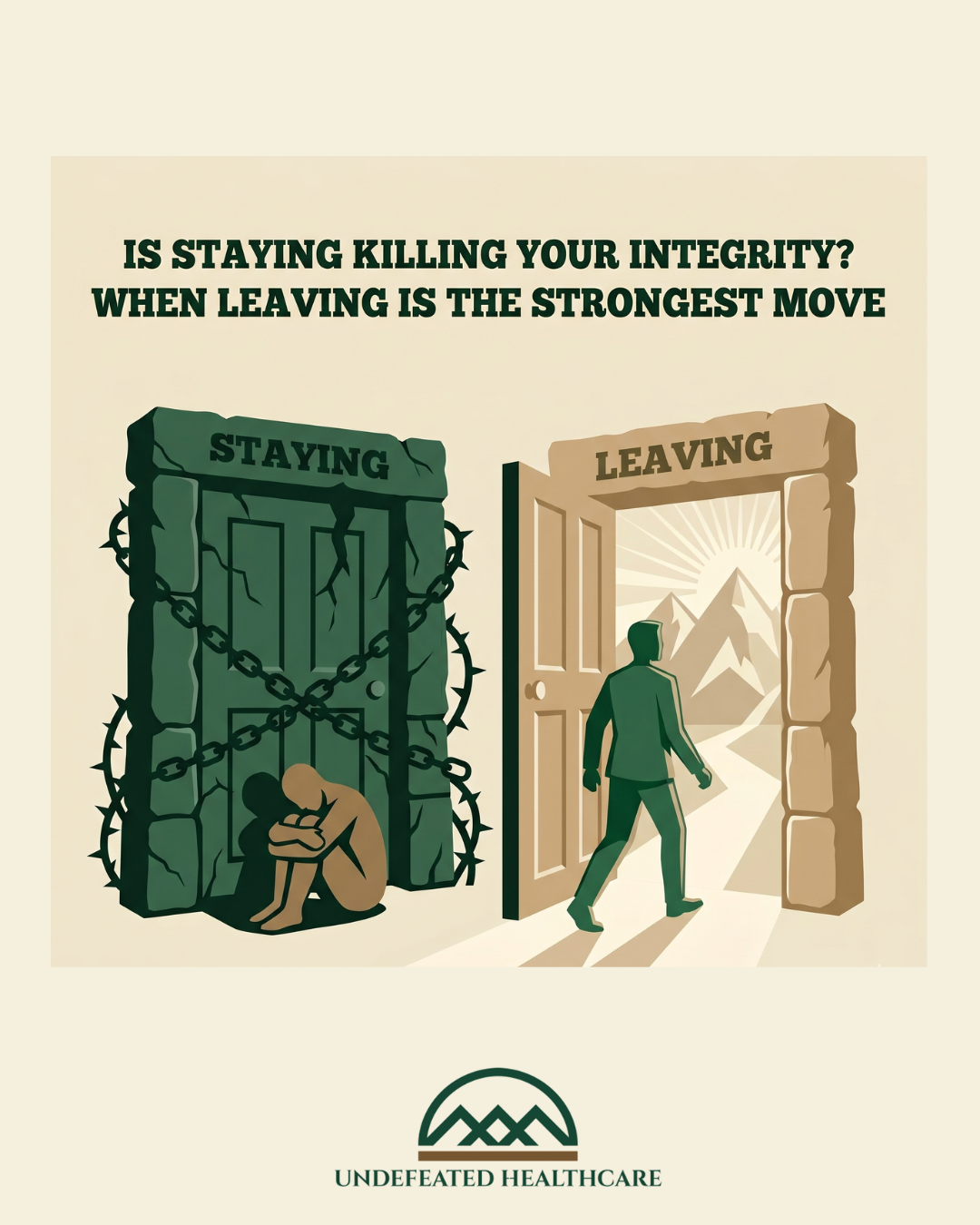
Stop telling yourself that staying in a failing relationship is an act of loyalty. Often, it is just an act of cowardice disguised as virtue.
We see this every day. You are 30, 40, or 50 years old. You have built a life, a home, and perhaps a family. You feel the cracks widening, yet you stay because you think "toughing it out" is the hallmark of a strong person. Here is the reality check: If you are staying because you are afraid of the fallout, afraid of the paperwork, or afraid of being alone, you are not being loyal to your partner. You are being dishonest to yourself.

Integrity is not just about keeping promises. It is about alignment. It is about your internal compass matching your external actions. When you live in a relationship that has died, you are violating your own integrity every single morning.
The issue is simple. We have been conditioned to believe that quitting is weak. Our culture rewards persistence, but it rarely distinguishes between productive persistence and destructive stagnation. When a relationship shifts from a partnership of growth into a prison of obligation, remaining in it does not make you a hero. It makes you a captive.
This is not about being "broken." We do not subscribe to that narrative at Undefeated Healthcare. We believe you are a human being with the capacity for greatness, currently stuck in a strategy that is draining your reserves. When you address the misalignment in your relationship, you are not fixing a defect. You are reclaiming your life and leveling up your capacity for future success.
As comedian Bill Burr once joked, "I think that's the problem with relationships. We think we're supposed to be in them forever. No, you're supposed to be in them until you learn what you needed to learn."
This is not a theoretical problem. This is a physiological and financial drain. Research published in the Journal of Social and Personal Relationships (2021) highlights that chronic relationship distress is not just a mental burden. It has significant, measurable impacts on immune function and physical health, specifically increasing the risk of cardiovascular events.
When you stay in a relationship that lacks integrity, the cost is not just your time. It is your health, your focus at work, and your parenting capacity. If you cannot be present in your own life because you are busy managing the resentment of a dead relationship, the financial cost of this "stuckness" is massive. Consider the lost productivity and the compounding medical bills that stem from untreated stress. Investing in therapy is a high-yield financial decision compared to the exorbitant cost of living a half-life.
Strength is not about brute-forcing a situation. It is about having the tools to handle reality with precision.
Next time you feel the urge to sacrifice your needs to keep the peace, pause. Ask yourself: "If I were the most confident version of myself, would I accept this situation?" Do this three times a day. This simple, one-minute check helps you distinguish between being kind and being a doormat.
Every Sunday, take 15 minutes to journal specifically about your relationship goals versus your reality. Write down one action you took this week that aligned with your values, and one area where you compromised your integrity to avoid conflict. This creates a data set for your own life, helping you move from reactive to proactive.
If you are struggling to discern whether it is time to move on or lean in, you need a professional to challenge your current framework. Here are three questions that will define your next move:
Am I staying because I value the connection, or because I am afraid of the discomfort of leaving?
If I were fully honest with my partner today about my internal state, would the relationship survive, and would that be a bad thing?
What is the specific price I am paying in my health, my career, and my personal growth to maintain the status quo?
You do not go to the gym to "fix" your body. You go to increase your capacity. Therapy is the exact same thing. It is a strategic intervention to build resilience.
A therapist at Undefeated Healthcare does not just sit and nod. We use evidence-based modalities to get you results:
Emotionally Focused Therapy (EFT): Used to identify the cycle of disconnection and determine if the bond is repairable or if the structure of the relationship is fundamentally misaligned.
Cognitive Behavioral Therapy (CBT): Used to challenge the limiting beliefs (like "I am not worthy of happiness" or "I am a failure if I leave") that keep you stuck.
Internal Family Systems (IFS): Used to understand the different parts of you that want to leave versus the parts that want to stay, helping you act as a unified leader of your own life.
You do not have to struggle in silence. Explore these resources to begin your journey:
The American Psychological Association (APA): They provide extensive resources on navigating major life transitions.
The Gottman Institute: Known for their research-backed approach to identifying the "Four Horsemen" that predict the end of a relationship.
Psychology Today Directory: A robust tool to find specialized support in your local area.
Continue reading the full field note
How do I know if the relationship is truly over?
If you have tried, with professional support, to communicate your needs and the patterns remain unchanged, you are likely dealing with a compatibility or structural issue, not a communication one.
Is it weak to seek help for relationship issues?
Seeking help is the ultimate display of strength. It takes more courage to admit you need a new strategy than to keep failing with an old one.
Does insurance cover this?
We accept all major insurance programs, including Blue Cross Blue Shield, Aetna, Cigna, United, and Tricare. Using the insurance you already pay for to secure your mental health is the most fiscally responsible decision you can make.
How to build emotional resilience after a breakup
The difference between healthy compromise and sacrificing integrity
Signs of emotional exhaustion in long-term relationships
You have spent enough time in the cycle of indecision. It is time to determine if you are building your future or just protecting your past. We have therapists with immediate availability, including evening and weekend appointments, because we know your life does not stop between 9 and 5.
Contact Undefeated Healthcare
Check out our other blogs and follow our social media channels for more strategies on mental toughness, relational health, and personal development. You are built for greatness. Let’s get to work.
Insight matters, but change needs a plan.
This article is educational and doesn’t replace evaluation, diagnosis, or care from a qualified professional.