Written By: Undefeated Healthcare Editorial Team
Reviewed By: Chase Butala MS LPC, LCPC
Welcome to Undefeated Healthcare, where we keep it real about mental health, sprinkle in some science, and laugh so we don’t cry (as much). Today, we’re talking about healing from trauma, what it actually looks like, what it takes, and whether this emotional rollercoaster ever lets you off. Spoiler alert: it’s complicated.
What Does “Healed” Even Mean?
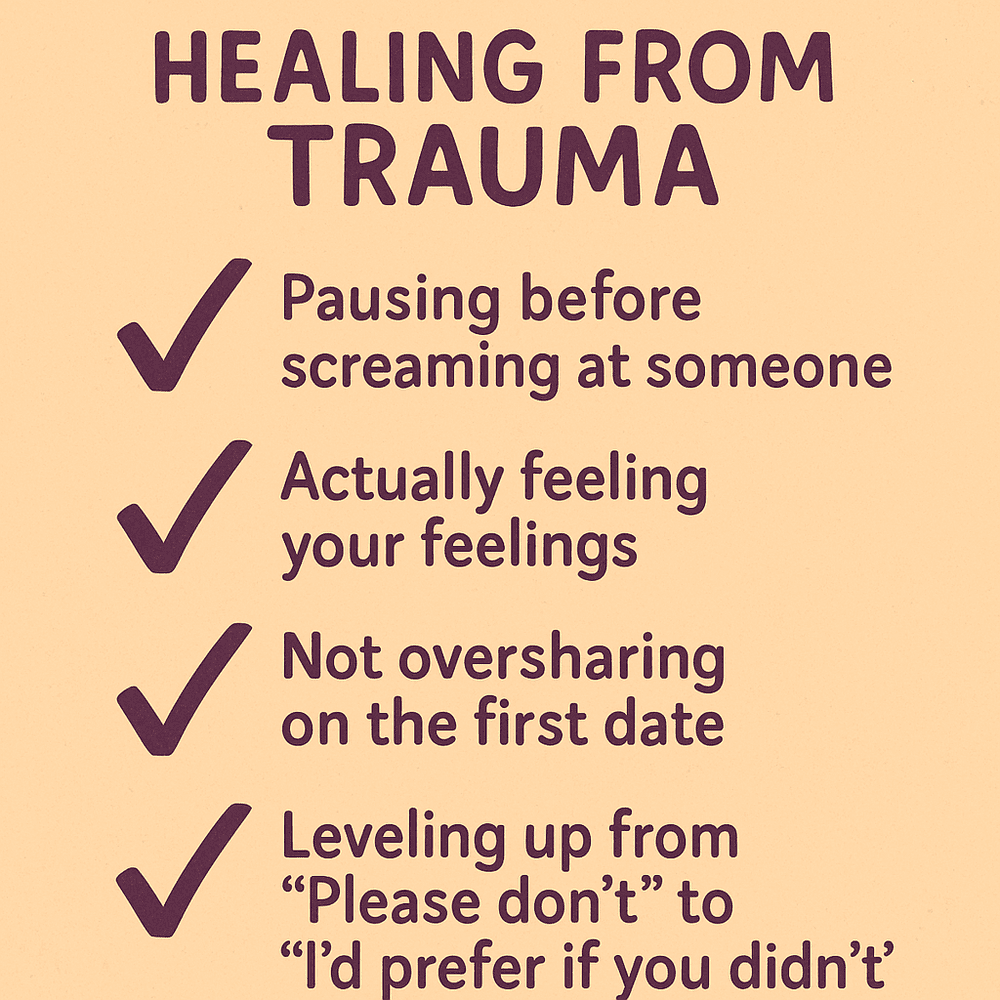
Contrary to popular belief, being healed from trauma doesn’t mean you levitate peacefully into a sunrise while wearing linen. There’s no glitter cannon at the finish line. “Healed” often looks like:
You notice your triggers instead of becoming one.
You pause before reacting (instead of flipping a table).
You feel things and don’t immediately shame yourself for it.
You stop trauma-dumping on the first date.
Your group chat sees fewer 3 a.m. texts that begin with “I swear I’m fine but…”
It’s not perfection. It’s progress. Healing is basically becoming a better you, with fewer emotional landmines and more compassion (especially for yourself).
Healing is not like binge-watching Netflix, you don’t just lay there and hope it gets better. It requires intention. Like going-to-the-gym-at-6am kind of energy, but for your brain.
Process: A.K.A. untangle the emotional spaghetti in your head. This could mean telling your story, identifying patterns, or realizing that your high school gym teacher yelling at you actually did leave a mark.
Cope: Learn how to ride the emotional waves without wiping out. Think: breathing, journaling, running, screaming into a pillow (therapist-approved).
Rewire: Your brain got a bit scrambled during the trauma. Healing involves reprogramming how you think, react, and relate to yourself and others.
According to research, trauma impacts the brain’s amygdala (fear center), hippocampus (memory center), and prefrontal cortex (logic center). Healing restores regulation between these areas, but it takes consistent effort. Think of it like upgrading from Windows 95 to macOS, but emotionally.
Inside and Outside the Therapist’s Office
Therapy isn’t the only path to healing, but it’s a darn good place to start. Let’s break down some fan-favorite interventions:
Cognitive Behavioral Therapy (CBT): Like Marie Kondo for your thoughts, what sparks anxiety? What’s just clutter?
EMDR (Eye Movement Desensitization and Reprocessing): Sounds like sci-fi but helps reprocess trauma by stimulating both sides of the brain.
Somatic Therapy: Because trauma isn’t just in your head, it’s also in your neck, shoulders, stomach, and that weird tightness in your jaw.
Internal Family Systems (IFS): Get to know your inner crew, like the anxious 8-year-old who still lives in your frontal lobe rent-free.
Journaling: Not just for middle school angst. Writing helps organize chaotic thoughts and lets your brain breathe.
Meditation/Mindfulness: You learn to sit with your feelings instead of running from them. (Warning: may initially cause more feelings.)
Support Groups: Nothing says healing like yelling “SAME!” in a room full of strangers who get it.
Creative Arts: Dance, paint, scream into a saxophone, your trauma might be allergic to silence.
Continue reading the full field note
Spiritual Practices: Prayer, rituals, or just shouting affirmations in the mirror like a hyped-up cult leader, whatever grounds you.
So… Is There an Endpoint?
Here’s the truth: healing isn’t a finish line, it’s more like a scenic loop trail with rest stops and occasional cliff dives.
Studies suggest trauma recovery is nonlinear, meaning you can feel amazing one week, then spiral the next because Mercury’s in retrograde and someone wore your scent. Researchers like Judith Herman and Bessel van der Kolk emphasize that healing is ongoing, especially because trauma reshapes identity, safety, and trust.
Healing may not “end,” but it evolves. The goal isn’t to erase the past, it’s to live well with it. You’re not broken, you’re complex. And healing means learning how to carry your story without letting it weigh you down.
In Conclusion (Sort Of?)
You’re not behind. You’re not doing it wrong. Healing from trauma isn’t linear, and it definitely isn’t always Instagrammable. It’s brave, messy, hilarious in hindsight, and deeply human.
So keep showing up. Keep laughing at the absurdity of your coping mechanisms. Keep healing, even if it’s just a little at a time.
And when in doubt? Take a breath, call your therapist, and maybe go scream into a forest.
You’re doing better than you think.
Insight matters, but change needs a plan.
This article is educational and doesn’t replace evaluation, diagnosis, or care from a qualified professional.